Rice Exports: Leveraging FTAs and Enhancing Brand Value to Overcome Challenges
Post Date: 18/12/2025 Hiệp Tài2026-03-05T13:51:14+07:00Content
ToggleEffectively leveraging free trade agreements (FTAs), improving product quality, and building strong brands will be the key for Vietnamese rice to affirm its position in the global market.
Amid volatility in the international market, Vietnam’s rice export sector is facing numerous challenges in terms of both volume and prices. At the Rice Export Business Conference organized by the Ministry of Industry and Trade on December 10, solutions such as leveraging preferences from Free Trade Agreements (FTAs), expanding into high-value markets, and building quality rice brands were emphasized as strategic directions to overcome these challenges.
Rice Exports Decline in Both Volume and Price
Speaking at the conference, Mr. Nguyễn Anh Sơn, Director General of the Import–Export Department (Ministry of Industry and Trade), pointed out a series of challenges facing Vietnam’s rice sector. Ongoing security and political instability in many regions, persistently high inflation despite some easing, and the slow recovery of global trade and investment are all exerting significant pressure. In addition, protectionist policies and increasingly stringent standards on food safety and sustainable development imposed by developed countries are creating new barriers for imported rice products.
According to data from the Customs Authority, in the first 11 months of 2025, Vietnam exported more than 7.53 million tons of rice, generating over USD 3.85 billion in revenue, with an average export price of USD 511.09 per ton. These figures represent a sharp decline of 10.9% in volume and 27.4% in value compared with the same period in 2024, a year that recorded a historic peak in rice exports.
Several key markets experienced severe contractions, notably Indonesia (down 96.38%) and Malaysia (down 32.5%). However, increased exports to Ghana (up 52.64%), China (up 165.14%), Bangladesh (up 238.48 times), and Senegal (up 73 times) have partially offset these losses.
Despite the difficulties, the Ministry of Industry and Trade, under the direction of the Government and the Prime Minister, has proactively coordinated with relevant ministries and agencies to introduce supportive policies for businesses. Mr. Trần Quốc Toản, Deputy Director General of the Import–Export Department, noted that 2026 is expected to bring new opportunities, as the Philippines plans to resume rice imports from January 2026. Moreover, the recovery of traditional markets such as China, Bangladesh, and African countries, together with the continuously improving quality of Vietnamese rice, is expected to enhance its competitiveness in the global market.
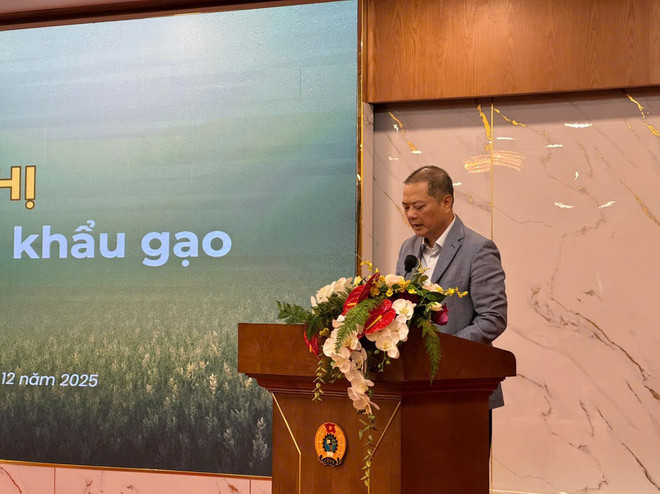 Mr. Nguyễn Anh Sơn, Director General of the Import–Export Department (Ministry of Industry and Trade), delivering remarks at the conference. (Photo: MOIT/Vietnam+)
On production, a representative of the Department of Crop Production and Plant Protection (Ministry of Agriculture and Environment) said that rice output in 2026 is expected to reach 43 million tons, a slight decrease due to a reduction of 0.2 million hectares in planted area. To ensure supply, the agency recommended that localities focus on restoring production after natural disasters, while accelerating the Project on Sustainable Development of 1 Million Hectares of High-Quality, Low-Emission Rice in the Mekong Delta by 2030.
Improving quality and building brand value
Mr. Lê Thanh Tùng, Vice Chairman and Secretary General of the Vietnam Rice Industry Association, emphasized that rice should be regarded as a special commodity that both ensures domestic food security and effectively meets export demand. He proposed establishing stable raw material areas that meet food safety standards and traceability requirements, and called on enterprises to participate in the 1-million-hectare high-quality rice project in the Mekong Delta.
Regarding the utilization of FTAs, Mr. Ngô Chung Khanh, Deputy Director General of the Multilateral Trade Policy Department, pointed out that Vietnamese traders have not fully tapped the potential of these agreements, especially in large, high-value markets. He suggested developing specific strategies, strengthening coordination between authorities and enterprises, and focusing on building the Vietnamese rice brand to enhance product value.
Representatives of Vietnam Trade Offices in countries such as the Philippines, Australia, and China recommended that enterprises exercise caution in transactions, particularly with the Philippine market, which is expected to resume rice imports in 2026. In addition, ensuring rice quality, compliance with quarantine requirements, appropriate packaging, and a clear understanding of partners’ payment practices were emphasized to optimize export efficiency.
Vietnam’s rice export sector is facing intertwined challenges and opportunities. Effectively leveraging FTAs, improving product quality, and building a strong brand will be the keys for Vietnamese rice to affirm its position in the global market. Close coordination among state agencies, associations, and enterprises will be the decisive factor enabling the rice industry to overcome difficulties and achieve sustainable development in the future./.
According to VietnamPlus