Effectiveness of the socialized model linking rice production and consumption
Post Date: 23/12/2025 Hiệp Tài2026-03-05T13:51:14+07:00Content
ToggleEFFECTIVENESS OF THE SOCIALIZED MODEL LINKING RICE PRODUCTION AND CONSUMPTION
Not only has it helped farmers in Xóm Thủ Hamlet (Long Bình Commune, Đồng Tháp Province) significantly increase their income in the 2025 autumn–winter crop, the ST25 rice production–consumption linkage model has also contributed to creating a “green revolution” in the fields. By reducing production costs and minimizing environmental emissions, this socialized model is emerging as a bright spot in the local roadmap toward sustainable agricultural development.
INCREASING FARMERS’ INCOME
Long Bình Commune is located in the eastern part of Đồng Tháp Province, within the Gò Công freshwater management project area, where farmers cultivate rice three crops per year. In the 2024–2025 winter–spring crop, the rice fields in Xóm Thủ Hamlet, formerly Bình Tân Commune and now part of Long Bình Commune, implemented the Project on Sustainable Development of One Million Hectares of High-Quality, Low-Emission Specialized Rice Cultivation. The project covered an area of 11 hectares with the participation of 18 households, achieving a yield of 7.5 tons per hectare and demonstrating high efficiency.
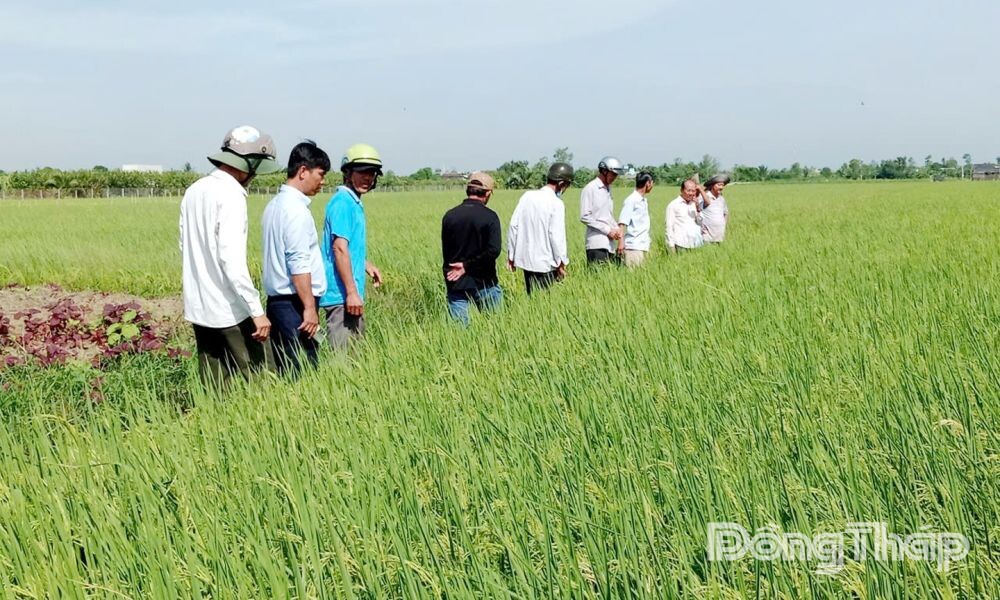
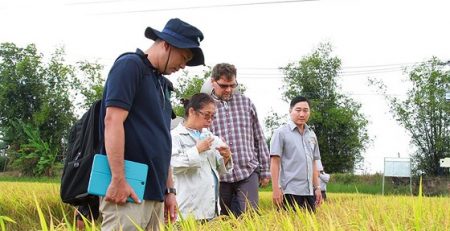
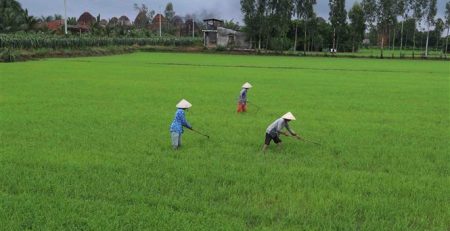
The Economic Office, the Cooperative, the Commune Farmers’ Association, and farmers visited the rice fields during the heading stage
Therefore, in the 2025 autumn–winter crop, Hòa Thạnh General Agricultural Cooperative, representing farmers in the Xóm Thủ area, coordinated with Phước Lộc Thiên Hộ One Member Limited Liability Company (hereinafter referred to as Phước Lộc Thiên Hộ Company) to implement a socialized linkage model for the production and consumption of ST25 rice, on a scale of 50 hectares with the participation of 74 farming households.
Accordingly, Phước Lộc Thiên Hộ Company supplies rice seed and organic fertilizer to farmers through Hòa Thạnh General Agricultural Cooperative, and purchases the farmers’ rice products through the Cooperative. Farmers carry out cultivation in compliance with the technical procedures and guidelines provided by the Cooperative and Phước Lộc Thiên Hộ Company.
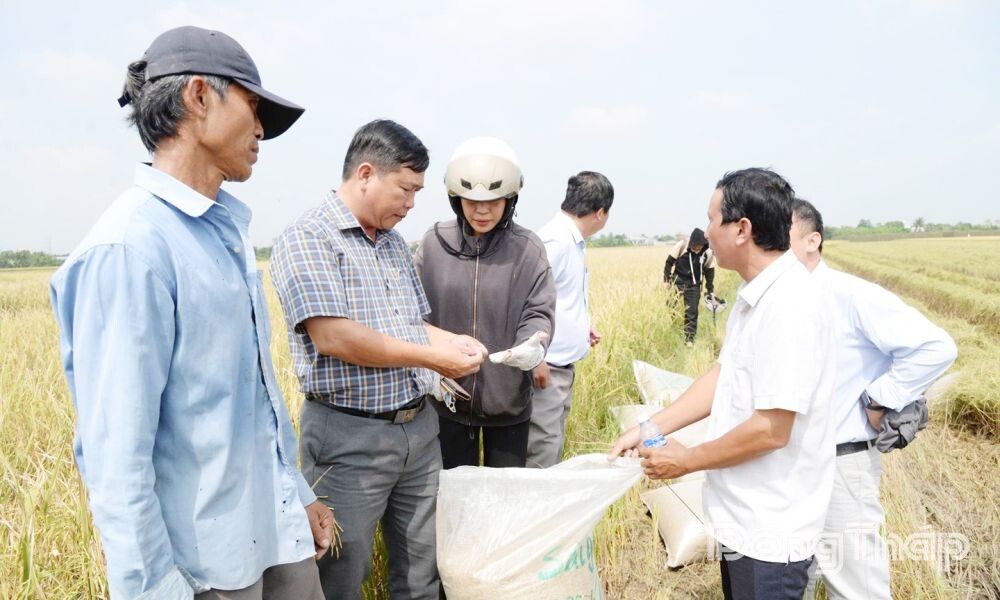
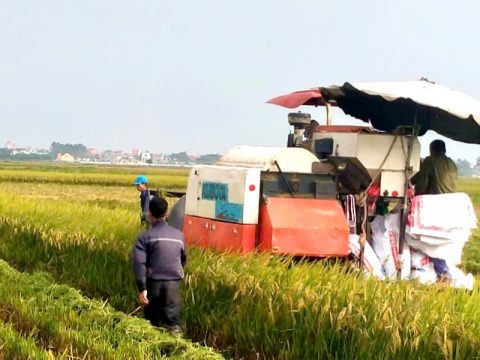
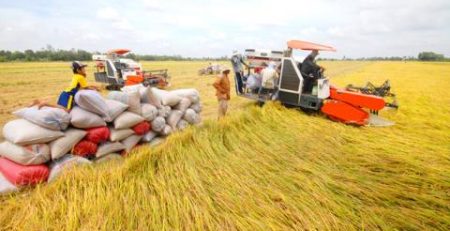
Leaders of the Commune Party Committee, the Commune People’s Committee, specialized departments, and mass organizations visited the model on the rice harvest day.
When participating in the model, farmers were trained in technical practices such as the application of “Three Reductions, Three Gains” and “One Must, Five Reductions”, together with experience gained from implementing the One Million Hectares High-Tech Rice Project in Xóm Thủ Hamlet during the 2024–2025 winter–spring crop (synchronized sowing according to the cropping calendar, balanced use of fertilizers and pesticides, and reduced nitrogen fertilizer in accordance with prescribed standards). As a result, the model achieved high efficiency, further affirming the advantages of applying technical advances and value-chain linkages.
Specifically, by adopting sustainable farming practices such as sparse seeding at only 130 kg/ha (a reduction of 70 kg/ha compared with non-model fields), combined with Integrated Pest Management (IPM) to minimize the use of plant protection chemicals, the model significantly reduced production input costs.
According to the analysis of the Long Bình Commune Economic Office, with an appropriate seeding rate of 130 kg/ha, rice plants grew well and uniformly, with low pest and disease incidence, and almost no need for insecticides.
Thanks to reductions in seed, fertilizer, and plant protection chemicals, total production costs decreased markedly compared with conventional farming practices; yield reached 5.6 tons/ha, 0.1 ton/ha higher than outside the model; and average profit reached VND 23.7 million per hectare, which is VND 14 million per hectare higher than that of non-model production.
This model ensures stable market outlets, helping farmers avoid price pressure from middlemen, which is a key factor contributing to increased profitability.
Many participating farmers reported that the model delivers tangible benefits, reducing input cost pressures, limiting pest and disease outbreaks, and providing stable income.
Mr. Lê Văn Tròn, a farmer from Xóm Thủ Hamlet participating in the model, shared: “My family voluntarily joined the high-quality, low-emission rice production model of Hòa Thạnh General Agricultural Cooperative. With both input and output linkages with Phước Lộc Thiên Hộ Company, our costs were reduced by about 30%. Like other farmers in the ST25 rice model, our harvest achieved good yields and higher income compared with non-model production, so we are very pleased.”
Several other farmers also expressed their desire for the model to be maintained and expanded in future crops, especially with continued product off-take by enterprises at agreed prices.
SCALING UP THE MODEL
Mr. Đào Hồng Phong, Vice Chairman of the Long Bình Commune People’s Committee, stated: “Based on the evaluation, the linkage model for the production and consumption of ST25 rice in Xóm Thủ Hamlet has achieved positive results, contributing to increased income for farmers.”
.jpg)
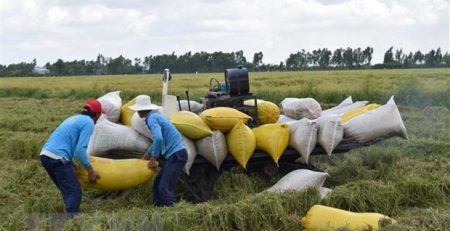
Phước Lộc Thiên Hộ Company purchases rice from farmers.
In the coming period, the Commune People’s Committee will continue to replicate and expand the ST25 rice model, primarily through linkages with Phước Lộc Thiên Hộ Company to supply seeds, fertilizers, and input materials, thereby reducing production costs for farmers.
The company also commits to purchasing rice at prices higher than the market rate. This contributes to increasing farmers’ income, creating environmentally friendly products, and promoting sustainable agricultural production.
The ST25 rice production linkage model is regarded as a “bright spot,” aligning with the orientation toward restructuring production and advancing high-tech agriculture in the commune.
Ms. Dương Thị Hoàng Loan, Chairwoman of the Long Bình Commune Farmers’ Association, shared: “Based on the results of the ST25 rice model, the Commune Farmers’ Association will continue to promote and mobilize people to replicate the model, raise awareness of low-emission production, limit environmental pollution, and especially build a local brand, thereby contributing to enhancing the commune’s agricultural economy.”
The model helps farmers change their production mindset, confidently adopt advanced techniques, and at the same time establish a high-quality rice raw material area to serve enterprises.
Hòa Thạnh General Agricultural Cooperative and Phước Lộc Thiên Hộ Company also affirmed their continued partnership and expansion of the linked cultivation area in upcoming crops, aiming to build a sustainable rice production–consumption value chain in Long Bình.
Mr. Thái Văn Cẩm, Director of Phước Lộc Thiên Hộ Company, highly appreciated the locality’s agricultural potential: “The soil conditions in Long Bình are particularly suitable for ST25 rice. With yields reaching nearly 6 tons per hectare in the recent crop, both farmers and enterprises are very encouraged, creating motivation for us to make long-term investments here. From the initial success of the 50-hectare linkage, we plan to expand the scale and double the linked area to 100 hectares, in order to spread economic value and attract more households to participate in sustainable production.”
The socialized linkage model for the production and consumption of ST25 rice not only helps farmers increase their income but also opens up a new development direction for Long Bình’s agriculture in the coming time.
Especially in the context where the rice sector is facing many challenges, the model of high-quality, low-emission rice production is considered a highly promising path for farmers.
By HOÀI THU – QUỐC NHẬM (baodongthap)