Vietnam to Apply Remote Sensing Technology in Rice Production
Post Date: 23/07/2019With this technology, agencies in the agricultural sector can access accurate, objective, and timely data, thereby improving the efficiency of rice production and, in particular, strengthening natural disaster risk management.
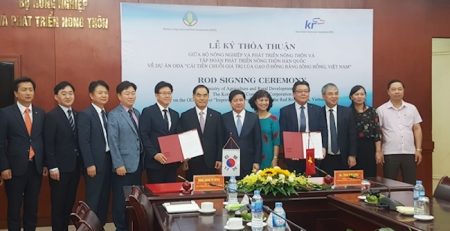
On the afternoon of July 17 in Hanoi, the Ministry of Agriculture and Rural Development (MARD) and the Swiss Agency for Development and Cooperation (SDC) signed an agreement for the project “Remote Sensing Information and Crop Insurance System for Emerging Economies – Phase 3” (RIICE).
The Swiss Agency for Development and Cooperation (SDC) will provide a non-refundable grant of CHF 365,000, equivalent to 82% of the total project value, to carry out the final steps toward institutionalizing and integrating RIICE into the official rice cultivation and production monitoring system of MARD. The Ministry of Agriculture and Rural Development will contribute the remaining 18% of the project funding.
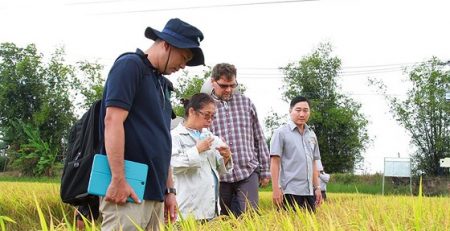
In the previous two phases, international and domestic partners conducted pilot tests and parameter calibration. In Vietnam, the National Institute of Agricultural Planning and Projection (NIAPP) and Can Tho University (CTU) carried out field measurements and validation, as well as data processing, in Vietnam’s two major rice-growing regions: the Red River Delta and the Mekong Delta.
The Ambassador of the Swiss Confederation to Vietnam, Ms. Beatrice Maser Mallor, stated that domestic partners have mastered technical operations and applied advanced technologies such as remote sensing and cloud computing to support stakeholders across the rice value chain, especially smallholder farmers.
“With this technology, agencies in the agricultural sector can access accurate, objective, and timely data, thereby improving the efficiency of rice production and, in particular, enhancing natural disaster risk management,” Ms. Beatrice Maser Mallor said.
RIICE uses freely available satellite signals to generate and provide useful information to relevant agencies, such as maps of rice cultivation areas, data on rice acreage, and rice yields. With these datasets, authorities can easily monitor the actual situation of rice production.
Disaster monitoring maps—covering drought, floods, saline intrusion, and other hazards—will help farmers and local authorities respond more promptly and effectively.
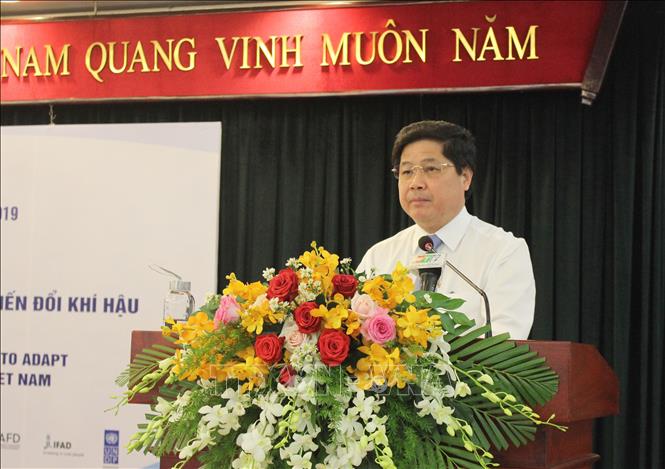
Mr. Lê Quốc Doanh, Deputy Minister of Agriculture and Rural Development, delivers the opening speech at the forum. Photo: Xuân Anh/TTXVN
Deputy Minister of Agriculture and Rural Development Lê Quốc Doanh noted that the project has helped Vietnam’s agriculture further promote agricultural restructuring through the adoption of new and advanced technologies, especially in the context of adapting to current climate change.
Phase 3 of the project aims to improve the rice production monitoring system and enhance the management capacity of the Ministry of Agriculture and Rural Development by institutionalizing technologies such as developing procedures, tools, and products that apply remote sensing technology in rice production, as well as implementing Vietnam’s crop insurance program.
Deputy Minister Lê Quốc Doanh expressed his confidence that, building on the success of the previous two phases and with the support and cooperation of domestic and international partners, Phase 3 of the project will be successfully implemented.
RIICE is a public–private partnership program funded by the Swiss Agency for Development and Cooperation (SDC) and the German Federal Ministry for Economic Cooperation and Development (BMZ), aimed at applying technology to support crop insurance for farmers.
RIICE is implemented by a consortium comprising the International Rice Research Institute (IRRI), the German Agency for International Cooperation (GIZ), Sarmap (Switzerland), SDC, and Swiss Re.
Since 2013, SDC has supported the implementation of the RIICE project in major rice-producing countries in the region, including Cambodia, India, Indonesia, Thailand, and Vietnam.
Bích Hồng (VNA)